Thursday, June 2, 2011

Kuna Yala

Kuna Yala means in the Kuna language "Kuna territory." It is also known as San Blas, a name given to this territory by the Spanish conquistadors and which remains to this day. The region borders on the west with the Province of colon and on the east with Colombia, to the south you find the provinces of Panama and Darien and the 365 islands that make up the archipelago that extends out into the Caribbean Sea.

Most of its population is concentrated in these islands. By the mid 19th century they started populating the islands of the archipelago. The continental part of the "comarca" (territory) is mostly uninhabited. They have been able to preserve the biologic diversity of the region and their culture.

For the Kunas the land is the mother of all things. She is the guardian of all that exists and represents the spirit, the strength and the vigor of the Kuna culture. The elders have taught the Kuna people that there are 8 spiritual levels in which they can find themselves: gold, silver, iron and other minerals that maintain Mother Earth. If they allow these minerals to be exploited, their trees will dry up and production will decrease. That it is why it is so important for them to take care of the environment and not abuse it.

The Kuna culture is one of the most studied and their traditions amaze and surprise tourists. One of the most striking practices is the fact that their young do not receive their names until they reach puberty. Until they reach puberty, the Kuna women are called by a nickname. The women wear the beautiful "molas." Molas are considered one of the most sophisticated handicrafts in Latin America. They are made from brilliantly colored cotton textiles. Cuts are made in the clothe making layers which are later sewn. To complement the molas, the women wear brightly colored cloths tied around their waist, in a manner of skirt and a red handkerchief with yellow designs on their heads. They also adorn themselves with necklaces, rings, and bracelets of gold with thich they complete their daily attire. The Kunas wrap their ankles and wrists in bracelets made from bright colored "chaquiras" (beads called winis in the Kuna language).

Their economy centers around the harvest of coconuts which they sell mainly to Colombian ships that sail in the region. Coconuts are traded for clothes, food or accessories such as sunglasses.

Another aspect that catches the attention of tourists is the high incidence of albinism in the Kuna territory. Experts attribute this to the fact that they rearely marry outside their community. Children of the moon, as the albinos are called, are revered and treated as special people.

Border crossing into Costa Rica from Panama

Guabito, Panama (and Sixaola, Costa Rica) is one of the few border crossings with Costa Rica, this one located on the Caribbean side, in the Bocas del Toro province. Guabito is a town in the Changuinola district of the Bocas del Toro Province of Panama. Guabito is a small town located directly across the Rio Sixaola from Sixaola, Costa Rica. An elevated former railroad grade and bridge connect Guabito to Sixaola. The border crossing is popular with tourists going between Costa Rica and Bocas del Toro. The Costa Rica-Panama border is also a time zone boundary so Guabito is one hour ahead of Sixaola. Few tourists stop in guabito longer than necessary to clear Panamanian customs.

The bridge across the Sixaola River is for both pedestrian and vehicular traffic and was built in 1908! A new bridge is very badly needed but Costa Rica and Panama are having discussions on its construction.

Panamanian amphibians victims of deadly fungus

Workers at the Maryland Zoo in Baltimore have spent the past decade creating a frog-breeding program that now makes the facility the largest U.S. breeder and shipper of the Panamanian golden frog. The program is part of a larger effort by the Association of Zoos and Aquariums to propagate the endangered species in captivity with an eye on one day rebuilding the wild population in its natural habitat.

The "waving" is a language of "hand" motions the frogs evolved to communicate amid the din of falling water in Panama that drowns out their chirps. Maryland Zoo veterinarian said the Panamanian golden frogs once were abundant in Panama. A national icon and a symbol of good luck, their image appears on the country's lottery tickets, in hotels and gift shops. But today they're absent in the wild, reduced by habitat loss, toxins and over-collection, then wiped out by the deadly chytrid fungus that has affected 30% of the world's amphibian species. They also discovered the frogs like running water in their tanks. So the adult tanks have a steady trickle of water falling through the lid. Temperatures are kept near 70 degrees, like Panama's mountain forests.

Wednesday, March 30, 2011

Hammocks!!


Like so many nations, Panama's country folk love their fairs. One of the most popular is the Azuero Fair (Feria de Azuero) held in Villa de los Santos in Los Santos province of central Panama. Azuero is the name given to the "hump" of central Panama that sticks out into the Pacific. Along with the standard country fair events, there are plenty of vendors selling crafts. Here's one of a kind of craft that we all definitely enjoy!

Contadora Island and Punta Manzanilla

Here is something special about standing on this beach, as this man does near Punta Manzanilla on the Caribbean coast in eastern Panama. You may be alone, but the surf provides ceaseless motion and sound. It is huge, but id doesn't frighten you, it calms you. You don't really "look" at anything, you experience it. It is not static, it is a living creature in its won right.

Off the Pacific Coast, a few minutes by plane from Panama City, are the Pearl Islands. This tranquil beach is found on the largest island, Isla Contadora. The name translates to "Accountant's Island" as this was the location of the counting-house for the Spanish pearl trade of past centuries. The island has eleven white sand beaches, including Panama's only beach for nude sun-bathing, Playa de las Suecas, literally Beach of the Swedish Women and sea from Panama City. But unlike the city, "traffic" here adds to the relaxing environment.

Caiman, nokeys and cows....

This is a "caiman," a smaller cousin of the crocodile. This particular follow is a "Spectacled Caiman," called that because he has a ridge between his eyes. Don't worry, you wont find him in your backyard in Panama! Indeed, you will be very fortunate if you ever see one as they don't hang out with humans and live only in remote locations. Our friend here was found by workers for Futuro Forestal, a reforestation project in Panama.

They are called "howler monkeys" and they are the loudest land animals. Measuring up to a yard (meter) in height, these monkeys are "folivores" which means they eat leaves, fruit, buds, flowers, and nuts, not us! Indeed, howlers are relatively friendly animals and are not threat to their Panamanian neighbors. However, a mother is a mother, so keep your distance when baby is asleep.


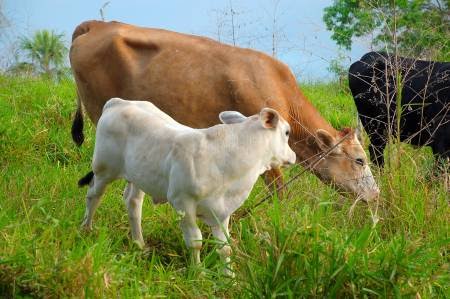
Chiriqui province in the fart west of Panama is our equivalent of America's Texas. Local folks are extremely proud of their province, and there are plenty of cattle. This fellow is very typical. Most Panamanian cattle are hybrids, but you can see the influence of the Brahma family in this gentleman.

All about fish!

You might be surprised to know that salmon is a popular fish in Panama. Of course, our native varieties, especially corvina, are the most common, but salmon has its place in the marketplace too. We even have a local producer of a variety of smoked salmon specialties whose products are also exported. Where do the salmon come from? From fish farms like the one on the left from cocle province in central Panama.


You can see part of Panama City's skyline in the background. The city and the surrounding suburban area are home to well over a million people and nearly all have one thing in common...they eat seafood! This is one of the seafood markets near the city where fishing ships head with their catch. The main seafood market in Panama City is very well run. It's a project sponsored by the Japanese government as a gift to all of us who live here. Now, that is a thoughtful gift.
In a small restaurant on the beach near Las Lajas in the Chiriqui province, this was a lunch special. Those round yellow items in front are patacones, fried slices of plantain. The plantain is a member of the banana family, but it's larger, starchier and not as sweet. It is used much like a potato and it's a perfect accompaniment for a fresh fish.